Monday, May 25, 2020

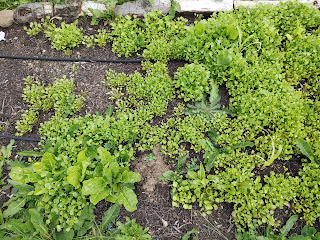
Recording the state of the annual veg beds

I want to remember how specific veggies and their arrangements worked, so here's a photo record of their state as of May 19, 2020.

Top level bed, from left to right (when facing west).


Second bed, left to right (facing west).  This first show is the Jerusalem artichoke, getting squeezed out.  :(


Third bed...


The fourth bed is unused and has piles of raw manure and wood chips.

Sunday, May 24, 2020

Biochar attempt number 3

Sigh.  Failed.
To save time, I'm just going to make the following photo link to the photo album that I have on Google Photos.  To those photos, I've added the comments that I would have put here.  I'm just too tired to pull everything in here.  Failure is demoralizing.  

After this failure, I re-watched https://youtu.be/RXMUmby8PpU.

Then I found this one, which answered a LOT of my questions, including how to pack the fuel, and the maximum the diameter/size of the fuel.

Jesus, what did people do before YouTube?  For all the things I want/need to learn, I would've had to use trial and error myself and take more than my lifetime, or find multiple mentors to apprentice under.

My understanding is growing, and that's good.  I want to eventually build a brick outer "barrel", around which I can leave space for wood that needs drying out.  Then I can use 55 gal barrel retorts inside of it.

Thursday, May 21, 2020

Seed starting next season

OK, the skylight shelves were great, but the temperature quickly got too high before I was done using them.  So I need them on a pulley system.  This would make caring for them much easier.  My hubby is against such a visible and permanent installation (currently the shelves are held up by Command strips).  Maybe if I can make it look stylish (steam punk?), with brass bits?

Regarding seed trays... yeesh.  I hate the ones that I have.  The cells are often too small.  And it's super hard to get the seedlings out.

I like the floating cell idea from Rodney Sidloski (https://globalnews.ca/news/5014096/weyburn-sask-man-finds-a-way-to-plant-a-two-penny-tree/).  I'd love to mix it with all of the alternative seedling containers I'm collecting.

So, maybe I can get styrofoam blocks from https://www.amazon.com/large-styrofoam-blocks/s?k=large+styrofoam+blocks and just cut holes in them, or depressions, which will allow me to sit my containers in them, with a hole through which the water will soak in.

Cool ideas from one of the many videos on YouTube

OMG OMGOMG OMG!  I just watched the following video, and it was SO packed with inspiring ideas!

And now I see they have a Q&A video too!  I need to watch this!

For now, I need to remember these ideas:
- Having a goat run!  Maybe around the food forest.  And right by the fence that will surround the food forest and separate it from the goats, grow herbs and good stuff for the goats that will come through the fence.  What a great way to protect your plants from goats.  I could even split the run into two to allow half to recover and re-vegetate.
- Oooh!  Could do that for chickens too!  Or have chicken runs go through the annual beds.
- Terraces should slow down the water that moves downhill.  I also like their "silt traps".
- OMG, the pizza oven!!  I'd love to have it pump heat through a cement lounger too.  Maybe have a sauna attached.
- Speaking of goats, I looked up combo fiber and milk goats, and read about nigora goats.  I joined the enthusiast group on Facebook.
- Speaking of growing forage plants through a fence, I still want a thorny, stock-proof hedge on our north side.  I'll keep it a couple feet away from the neighbor's fence, and grow horse herbs in that space.
- The IBC tanks that were cut in half to create raised beds, complete with water reservoir below with a wicking system, and an integrated worm farm, and integrated trellis... OMG!  Want!
- I love how they developed multi-level canopy in an inter-cropped way, in order to prep for delicate plants (ginger).

I know there was more... I'll have to watch it again.

Tuesday, May 19, 2020

Lesson learned: Look up the F:B ratio required by a plant

Dr. Elaine Ingham says, "Asparagus likes mostly bacteria, very little fungus."

Nyohhhh!!!  Is this why my asparagus didn't grow?  I inoculated them with mycorrhizal fungi.  :(

Why?  Because this list said it was ok.
https://fungi.com/pages/plant-list

But this list doesn't list asparagus. 
https://www.bio-organics.com/pages/specific-plants-trees-endo-mycorrhizae-and-ecto-mycorrhizae

Oh well.  Lesson learned... though I'd need to repeat the experiment to see if the results are the same.

Today's shot

My neighbor asked if she and a friend could have a tour of the garden.  In my head I was like, why?  
The difference between the picture in my mind and what it looks like now makes me feel like I'm only 10% of the way there.  But I guess if you look at what we started with, there is a lot of change.  I gotta remember that.  It'll be very encouraging to give a tour.  :)


Photo notes on May 19th, 2020

There's a bunch of these scattered around the property.  A friend on Facebook thinks it's barley.  I hope so.  I'm going to collect the seeds and use them next year.  Or, wait, isn't barley a winter grain?  I'll used them when I can.  The drivable path can't be used for row crops until I'm done trucking stuff onto the property, though.  :(

I finally decided where to put the hops.  I potted them carefully, with mycorrhizal fungi, and sowed clover for nitrogen, and watered with EM-1, and finally added some sweet alyssum seeds.  That was a week ago, and look how fast the clover sprouted.

The thingies are already curving around the post.

Finally set up the trellis for the kiwi plants I have, on May 14th, with fungi and clover.  I slash mulched all of the vegetation first.  I have 2 male Hardy, and 6 female of slightly different strains.


They're going gangbusters now.


Already winding like crazy around the wire.

Holy crap, look at the rhubarb!  It's setting seed.  It's taller than me.  And last year I thought it died.  Gonna harvest these seeds because they'll be genetically adapted to my soil and my neglect.  :)


Look where it was on April 30th when it started sending up the stalk.  The leaves were already big.  

Every day or so, I MUST go check on all the big plants I paid money for.  Because moles.  They raise up soil, often covering my stuff, but more importantly, exposing soil, which increases evaporation.  I spotted this around a new rhubarb and covered the exposed soil with slashed vegetation.

Holy cow!  The King Stropharia spawn I got last fall worked!!  This is at the base of one of my apples-from-seed.  Now I need to learn how to harvest the spores.

I saw so many damselflies today!!!  They started coming back last year.  Never saw them before that.


Another thing that came back!  This was a hazel that I got for free from a KNF meetup.  It seemed to die last year.  Man!  Patience pays off.  It went from a little barely-visible sprout 10 days ago to this.

This is disturbing, these brown spots on the rose leaves.  Last week, I made a point of spraying the roses with the EM-1 that I propagated.  I think I did this damage.  It's on all of the roses I sprayed, it's not on roses I didn't spray.  But luckily, it's not on anything else that I sprayed, which includes the veggies.  :(

Oh man, the dwarf apple--I sprayed the dwarf apple!  And now it's completely dead.  It was only mostly dead before I sprayed.  Fucking goats almost ringed it at the base.  But I thought it might come back.  I think they ringed the rootstock and not the scion.  Maybe that's why it didn't survive and thrive like the other two apples.  But I think I pushed it over the edge with the spraying.  I mean, there were 2 tiny, half-formed leaves that were alive and which are now dead.  Bummer.  MUST improve my EM-1 propagation skills.  I now have the pH test paper to make sure it's potent and not growing bad guys.  But I also need to get my microscope out and start identifying what's in my brews.

Finally got serious about biochar

Biochar is so important.  Look at the difference between corn grown without biochar and with biochar.


Three weeks ago, I attended a webinar with Peter Hirst that got me fired up.  Then I watched his video.

I had already built a biochar retort kiln like his in a 55 gallon drum, and tried a burn, but it failed miserably.  That was months ago.  The results were demoralizing.  I think the wood was wet in the retort, and I didn't get the fire outside the retort going for long enough.

After the webinar, I decided I needed to babystep it.  I watched this video.

Then I made 2 of these little TLUDS on April 30th, one using the same can sizes as in the video, and one using a gallon can and a quart can.

I did burns in each, using this supply of firewood.

The burn was fun, but it was a lot of wood to get through.  I kept feeding it in.  The flames always got as high as the top chimney can, even when I had 3 soup cans on top.

But look at the results.  So very little.  It was iridescent, but didn't sound like glass when dropped on each other.  Plus there was too much ash.


I later posted on the Biochar group on Facebook and got some good tips.  Making biochar is a batch process--you don't keep feeding wood, even in a little TLUD.  Plus, the starting fire has to be below the holes on the outer can.  

I'm gonna try again.  I'm also going to try a bigger burn using my retort kiln, but using a 16 gallon retort instead of the 30 gallon,  Maybe.

Monday, May 18, 2020

Propagating mycorrhizal fungi!

Yay!  I found out how to propagate my own fungi (since it's so darned expensive).  The instructions are at https://moldresistantstrains.com/diy-how-to-make-mycorrhizal-fungi-inoculant/

On May 6th, I sprouted some hard wheat in a jar, and once there were root tails (May 8th), I planted them in 50% vermiculite and 50% compost.


Now look at them!  May 18th.

It's now cat grass for my kitties, which doubles their usefulness.  Actually, I saved about 1/3 of the sprouted wheat to make Rejuvelac, so that's triple-usage!!

Sadly, I put the pot in the skylight for the first day and a half, and they got baked to about 90 degrees F, so I might've killed the fungi.  I'm afraid to look.  Maybe I should look.

In 4 months, the fungi should be just sporulating, but that's a known timeframe for Bahia grass seed.  Not sure what the time frame is for hard wheat.  Yeah, I'd better look.

I just gotta test for the unwanted kind of fungi (tricoderma) before I harvest it all and use it.

Update 6/4/2020:  There are no fungal hyphae.  I don't think this worked.  Either I killed it all when I put the pot in the 95 degree skylight shelf for a day, or wheat grass isn't ideal, or something.  Maybe the store-bought starter inoculant is bogus, which would piss me off, because it's expensive.  
I might retry by following the exact directions so that I can see what success looks like before trying to modify instructions.


Update 6/29/2020:  Well, the grass is dying, and there's still no hyphae.  Wheat grass is too short-lived to reach the 4 month growth period.  Also, why would you use only one kind of seed?  What if it only forms relationships with one kind of mycorrhizal fungi?  I think the best would be using multiple kinds of seeds.

Notes on potatoes

Note to self: Next year, dig trenches for your potatoes because look how much they have to be hilled up.  They're requiring so much soil that the level needs to be above the retaining wood!  May 18th.

In fact, I hilled-up a few last week, and that seems to have spurned them on, to grow even more by today.

Here's how they looked on April 30th (18 days ago).

Keep the dug out soil near the trench for easy backfilling and cover it with something to prevent weeds from making it hard to break up.  Or use clover.  Yeah.  Potatoes love nitrogen so use clover seed on the backfill soil.

Remember, though, that trenches will be cold traps.  Maybe put a cold air barrier on the uphill side of the potato bed, or just wait until the end of April to plant.